No-Slope
The rover only sees step and ripples obstacles during simulation pretraining. At the deployment site, the rover must learn to climb a slope, an obstacle it has never seen before.
Future planetary missions target steeper and more deformable terrain. However, on loose regolith, steep slopes amplify slip and sinkage. A rover with a passive suspension can dig in and become stuck, as shown below.
The ERNEST rover was designed to overcome extreme terrain challenges (see paper). It is a 75 kg rover with a two-degree-of-freedom Active Gimbal Suspension (AGS). Coordinated control of the AGS allows the rover to redistribute load, enabling crawling-like motions that can pull the rover through soft, steep terrain. Clips below from this video.
Coordination of the AGS can be trained with reinforcement learning (RL) in simulation. The simulator models some terrain properties (e.g., slip and sinkage), but not all (e.g., soil deformation and rut formation). This sim-to-real gap can result in zero-shot deployment failure. Therefore, the rover needs to be able to adapt at the target site. This adaptation must happen in real-time and be highly efficient, as the rover has limited energy to explore coordination strategies.
We introduce TERRA, an online adaptation framework that efficiently seeks deployment data exposing task-relevant model errors and corrects them. TERRA builds on the SimDist paradigm, which distills a world model from simulation and adapts it to the target domain. TERRA's main features are:
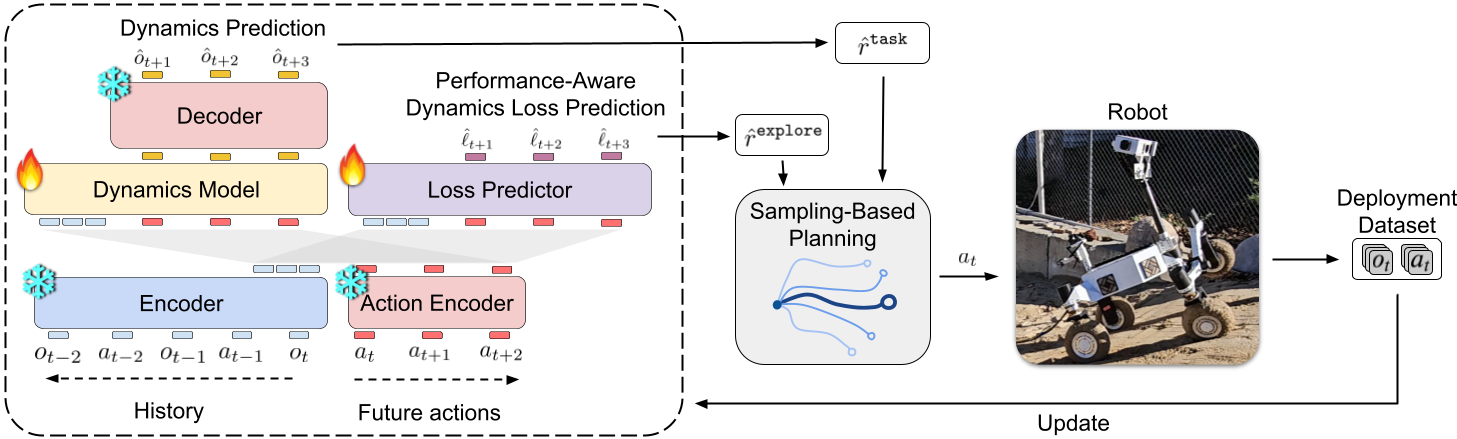
TERRA adapts a simulation-pretrained world model to the target site. To test TERRA, we pretrain in two out-of-distribution conditions, inducing a severe pretrain-to-deployment gap. Pretraining begins with RL as described in this paper, followed by world model distillation with SimDist.
The rover only sees step and ripples obstacles during simulation pretraining. At the deployment site, the rover must learn to climb a slope, an obstacle it has never seen before.
The rover is pretrained on slopes and ripples on hard ground, where it does not have to utilize the AGS. At the deployment site, the rover must learn to use the AGS to climb a soft-ground slope, which it has not experienced before.
The rover has never encountered a slope obstacle during its simulation pretraining. With TERRA's targeted exploration, the rover sucessfully learns to climb the slope after 5 trials.
Because the rover was pretrained on hard ground, it initially attempts to climb the deformable slope with forward motion alone. When this fails, TERRA automatically kicks in, exploring with the AGS. After only 3 trials, the rover learns to use the AGS to climb the slope.
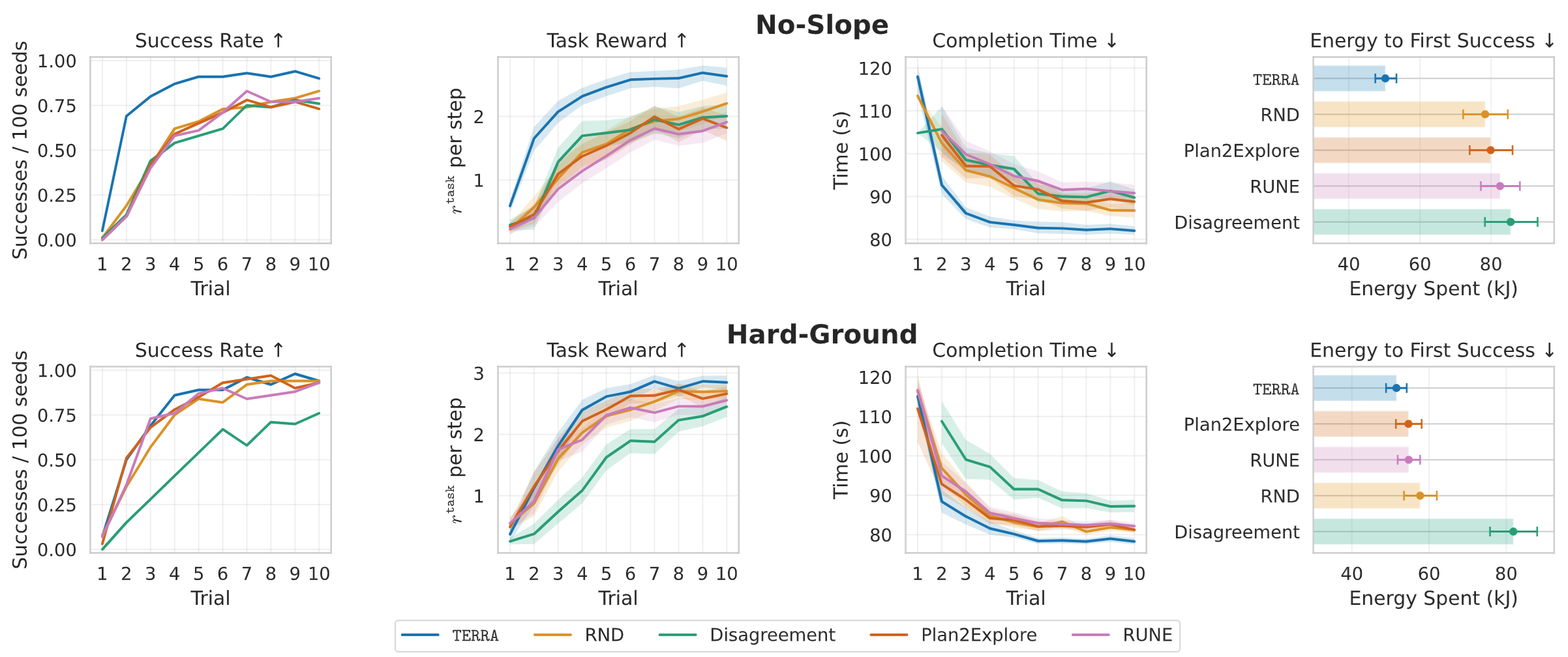
We compare TERRA with other exploration strategies in simulation, using the same two out-of-distribution pretraining conditions. TERRA achieves better or similar performance while using the least amount of energy.
This work was supported by a NASA Space Technology Graduate Research Opportunity under award 80NSSC23K1192 and by the National Science Foundation under Grant No. 2409535. The research was carried out at the Jet Propulsion Laboratory, California Institute of Technology, under a contract with the National Aeronautics and Space Administration (80NM0018D0004).